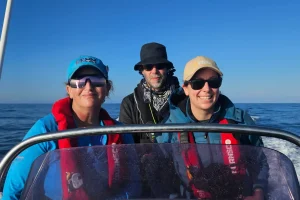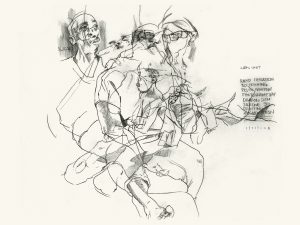
Meet Lily Gordon, a Communication Arts Junior in the Applied Arts Lab (AAL) course taught by Sterling Hundley and Jason Bennett. In AAL, students find solutions to real-world problems by combining their skills with visual arts. Some projects included in AAL are Comics for Medical, 3D Graphics for Simulation, and Game Development for Psychology.
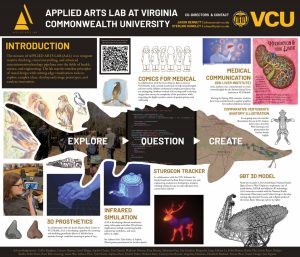
Lily has been working alongside the Evans-Haynes Burn Center at VCU Health to design innovative 3D models for their patients’ needs, such as splints or prosthetics. By developing a workflow for 3D scanning the body parts of patients and creating custom-modeled splints, Lily and the VCU Health team are able to account for the unique conditions of each individual to preserve their range of motion and take up a smaller amount of space. Through this combination of art and medicine, VCU has much to gain from exploring the rapidly expanding technique of 3D printing, specifically in this 3D printing as burn care niche. This would not only present as a milestone in patient care, it would reinforce the prowess and interdisciplinary knowledge of VCU.
Administrative Affairs Coordinator, Taylor Colimore, and current undergraduate student, Sofia Rahnama, spoke with Lily about the progress of the project and learned more about her passionate reasoning that initially inspired her work.
What is the project you’re working on in Applied Arts Lab?
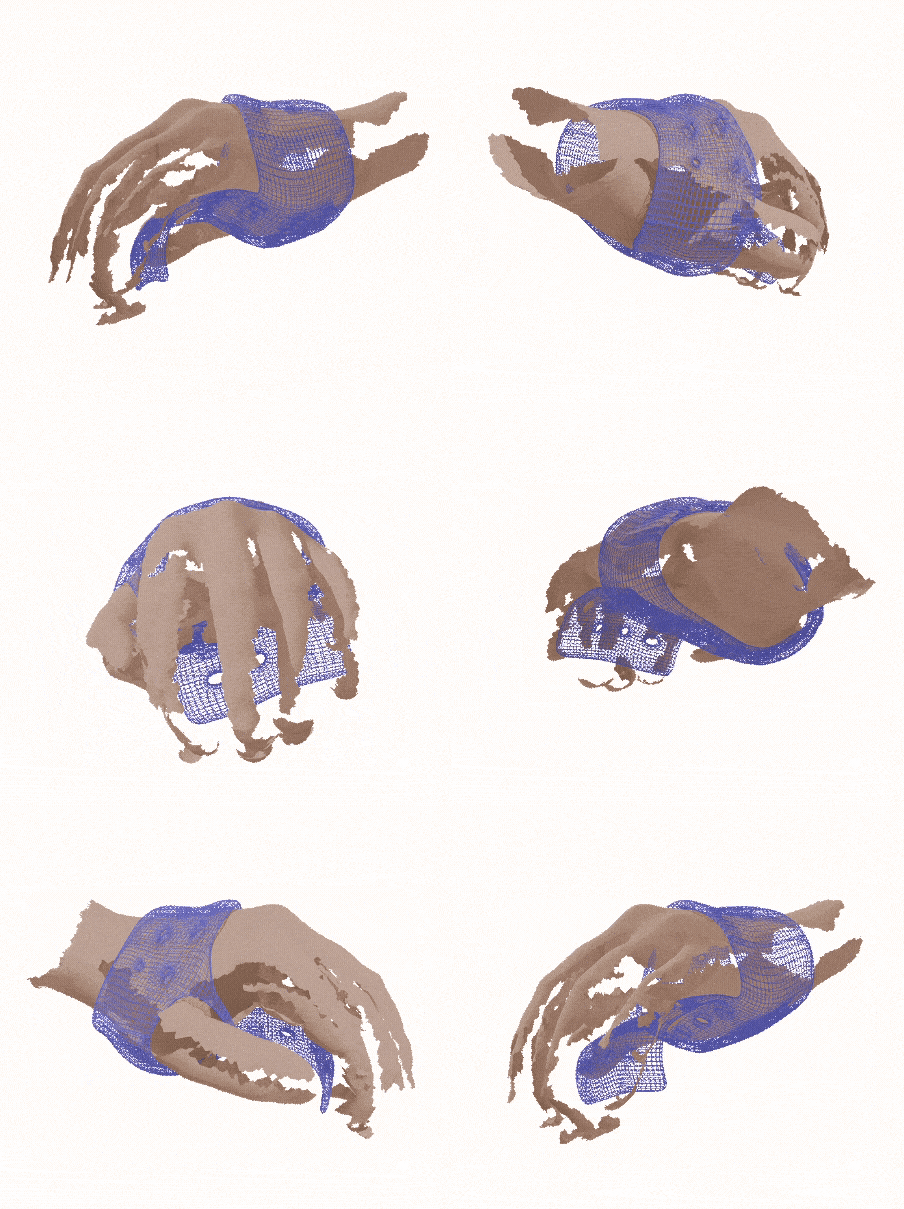 I’m working on a project with the The Evans-Haynes Burn Center at VCU Health to use 3D modeling and computer design in ways that can help patients or providers. Some of those applications have been designing splints, especially for burn patients, and I’ve looked into anaplastology and prosthetics as well. Most of what I’m doing right now involves looking at mechanical issues and figuring out how to solve them. I’ve been working with the PT and OT teams with splint creation because when you’re a burn patient with extremely fragile injuries, because it’s mostly on the exterior you have very different needs as opposed to someone who needs a cast. They also see a lot of pediatric patients like kids and babies, and trying to design stuff for them is even harder. So I’m coming to them saying “Hey, I know how to do this stuff [3D modeling] and you know all the medical stuff, let’s team up”, offering them my 3D modeling skills in a different context.
Did you come up with the idea for the project yourself or alongside someone else?
Professor Sterling Hundley came up with it first. I remember he pitched the project to me when I was in the Virtual Murals course. I thought it sounded awesome because he was specifically talking about how sometimes when hospitals have to come up with something that’s a custom design for a specific thing or person, they don’t always have solutions. They kind of have to just kitbash one together. He talked about a case of a little girl with a compression plate, and how they actually turned to Etsy. He described it as a big hulking thing on her head, and he thought “surely there’s a more elegant solution that an artist could design.
Tell me about the device you’re holding in this picture:
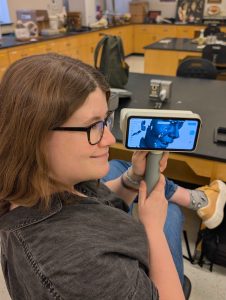
We wrote a grant for a medical quality 3D scanner that’s designed specifically for body parts and medical applications, so for example I could put my hand in front of it and get a really good 3D model of my hand that’s accurate and to scale. Traditionally this one is used for prosthetics, so you can scan the parts you need and you can get really accurate 3D models that you can then import into Blender or Maya and work on them from there.
Tell me about using Blender or Maya to touch up the scans.
A brace for a hand was my proof of concept. I had a model of my hand and designed a splint around it as if it had been injured, then I printed the splint and actually wore it. It wasn’t the best because it was my first try.
Have any patients used any of your models yet?
Not yet because we have to get through some material hurdles. The issue is that 3D printing, while awesome, is a bit time consuming. It’s faster than some traditional methods. Right now one of the reasons 3D printing has such a good case is because the main material that’s used for cast design and splint design is thermoplastic, which is a big sheet of tough plastic, and when it gets hot it gets soft and malleable to whatever shape it’s on. But in the case of burn patients, we wouldn’t want to risk the discomfort of them having a hot object put on them. It’s also difficult in the case of a small, delicate body part. A benefit is that you can get very precise models. What we have to think about now is materials, because PLA printer material is not biosafe because of the small ridges that catch so much bacteria, and you have to be very careful about infections with burns, or on anyone’s injuries, because it’s probably going to be something they have to wear on their skin for a long time.
I know the main focus right now is making the models and making them as accurate as possible, but have you come up with any solutions to the material problems?
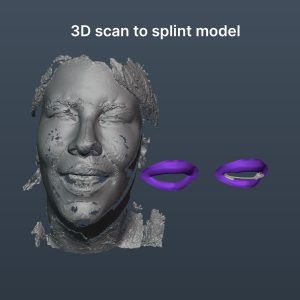 We were looking into biosafe resin or even silicone, but it kind of depends on the use case. Right now I’m working on mouth splints, which is sort of a unique issue, because when you have a facial burn, your skin shrinks and it could reduce the size of your mouth. With all the scar tissue it makes it hard to eat and talk. So in that case, we want something that’s going to be ok in someone’s mouth for a while. So we looked at biosafe resin, which the Engineering Department 3D printers actually have. I just have to get special permission to use them. But in the case of other things that might be more external, we probably have more options. Applied Arts Lab is open to all majors, so I hope that we have students from other majors that can point to issues that art majors can help design.
What do you think of the emotional impact of the designs for this project?
The Burn Center tries very hard to consider the emotions of the patients, like for example there’s a play area for kids because there are a lot of pediatric patients. That’s something that I wanted to reflect, because if you’re gonna be required to wear something like a splint for a long time, it should be meaningfully designed. It should be beautiful.
I have a lot of medical issues, and art was always my coping mechanism for dealing with those things and how stressful they would be. A lot of what I do now for this project is taking things I wish were taken into consideration for me when I was younger. A lot of medical devices are designed for efficiency. They’re kind of like “one size fits all”, which is not true because everyone’s different. Especially when it comes to the physical shape of someone’s body.
I wear medical devices 24/7, like an insulin pump and a glucose monitor. I’m of the belief that those physical objects shouldn’t just be throwaways, they should have more thought behind the design. When I wear my glucose monitor, it’s upside down to everyone else but rightside up to me. They were thinking about the wearer when they made it. There are so many products that we use everyday for self care and medical purposes that it’s very obvious no one thought about an easily-accessible interface. That even applies to devices I’ve seen nurses use. If I’m using something all the time, I want it to be intuitive, beautiful, and easy. I don’t want to be fighting with the device or medical tool I need to use that insurance will charge me the same for whether it works or not.
Where do you see this project being when you graduate? What do you plan to do relating to the project after graduation?
I want it to be something in AAL that exists long term, and will continue after I graduate. I hope to work on it for a long time. As long as there’s someone who’s passionate about it, that makes me excited for the future of the project. Everyone’s welcome.