Kat Thompson (M.F.A. ’23) doesn’t see herself as strictly a photographer.
“I love the medium,” she says, “but I use it as a tool.”
That interdisciplinary approach is what led her to VCUarts Photo + Film, where she believed the graduate photography program would nurture that exploration rather than limit it.
“In grad school, I didn’t leave [photography] behind but I started bringing it to light in a different form,” she says. “I started sewing in grad school. I wanted to make these textile collages that were heavily inspired by Southern quilting, and I was thinking about the labor embedded in the form and the ways quilting carries intergenerational storytelling, memory, and survival. But making it Jamaican.”
One of her most influential moments took place in a seminar on diasporic art, taught by Tobias Wofford, associate professor of art history. Before his class, Thompson’s practice was a journey of self-discovery and learning more about her own Jamaican and American roots. She used traditional photography to make portraits of herself surrounded by materials and objects that reflected her identity.
But Wofford opened her eyes to other experiences of people and materials that came from one place and were placed in another, then given a new narrative and identity.
“That is a lot of what I’m uncovering in my own practice, using Jamaican ephemera like souvenirs and postcards, found family photos and home videos from the ’60s and ’70s,” she says. “He was the catalyst for decentering myself. His class really got my brain flowing.”
While Wofford was instrumental in expanding the themes of Thompson’s work, Chris Mahonski, instructor and digital fabrication technician in the Department of Sculpture + Extended Media, was key to her integrating new mediums. With his guidance, she began to build her own frames and a table and meld photography with wood, acrylic, and other materials.
“If I didn’t take his digital fabrication course, half of my MFA thesis would not have existed,” Thompson says. “It was nice to work with someone who’s so versatile at crafting materials, putting things together, assemblage—but also open to new ideas.
“Because of Wofford, Mahonski, and my thesis committee, Tesora Molina-Garcia and Mark Boulos, today I’m still thinking about how to expand materials,” she says. “The material itself, but also how to recontextualize it into something else. Confronting the material and its narrative is very prominent in my work. Without them, I don’t think I would be thinking and making the way I am.”
Thompson is continuing to explore “the offshoots of what constitutes an identity,” as well as belonging and assimilation in the context of the diaspora. Photography still plays a central role as she experiments with large-format images, printing on fabric, and making textile collages.
A spate of fellowships, residencies and exhibitions have continued to foster her growth as an artist, granting her access to studio space and archival material, as well as encouraging collaborative relationships with other artists. Recent highlights include the Gibbs Street Residency with VisArts in Rockville, Maryland; an artist-in-residence with the Women Photographers International Archive in Miami, Florida; and a residency at the Watermill Center in Long Island, New York. She also received a Wherewithal grant from the Washington Project for the Arts and the Andy Warhol Foundation for the Visual Arts, and is preparing for a summer residency with Bemis Center in Omaha, Nebraska.
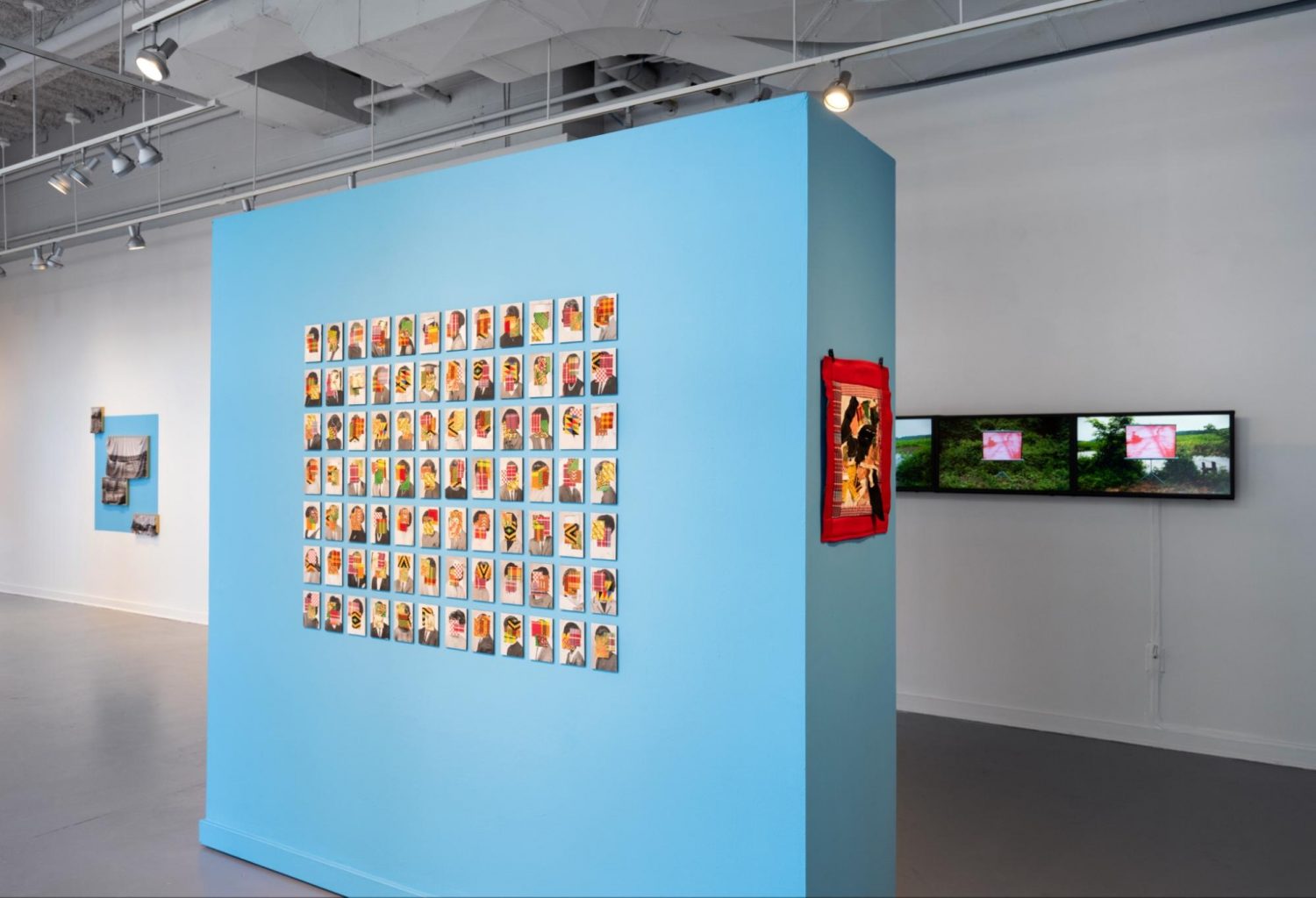
“The residencies are great because they give me a chance to leave Virginia and experience another location alongside other artists that I’ve never met before,” she says. “It’s also a way for me to indirectly collaborate with those artists, because I’m picking up on what they’re doing, I’m learning new things, and getting feedback that I’ve never heard about my work.”
And in a full-circle moment, Thompson has returned to her undergraduate alma mater, George Mason University, where she’s teaching an introductory digital photography course. She is also an instructor at American University and Northern Virginia Community College.
While her classes focus on digital photography techniques, they’re naturally infused with the same interdisciplinary experimentation that drives her artistic practice. She encourages students to look beyond the camera and consider burning, scanning, manipulating, or collaging their images.
“I approach it the way that I was taught,” she says. “We look at photography as more than a medium, but another way to express themselves, another way to escape their everyday selves—because a lot of my students aren’t art majors. I want to give them space to be creative and get them to have a different understanding of what photography is.
“I’m teaching them the techniques, but I’m also teaching them that the photo can be an art object.”
Lead photo by Carolina Porras Monroy.