This spring, the work of several Painting + Printmaking alumni can be found in exhibitions in New York, Paris and Dubai.
Malcolm Peacock (B.F.A. ’16)
Whitney Biennial 2026, Whitney Museum of American Art, New York City
Mar. 8–Aug. 23, 2026
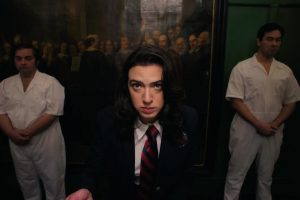
Malcolm Peacock is one of 56 artists, duos, and collectives who will appear in the 82nd Whitney Bienniel, the longest-running survey of contemporary art in the U.S. Peacock’s work often utilizes and alternates common physical actions—talking, gazing, braiding, singing, running—to emphasize the stakes and feelings that accompany being present in proximity to others and to one’s self. His art looks closely at ways that intimacy creates emotional spaces occupied by Black folks.
Whitney Biennial 2026 offers a vivid atmospheric survey of contemporary American art shaped by a moment of profound transition. Rather than offering a definitive answer to life today, this Whitney Biennial foregrounds mood and texture, inviting visitors into environments that evoke tension, tenderness, humor, and unease. Together, the works capture the complexity of the present and propose imaginative, unruly, and unexpected forms of coexistence.
Ali Kaeini (M.F.A. ’23)
Missed Mist, NIKA Project Space, Paris
Nov. 1, 2025–July 3, 2026
The new works by Iranian artist Ali Kaeini engage with the mechanics of human imagination under conditions in which parts of what is visible, and even thinkable, are displaced by censorship or self-censorship. In such circumstances, the mind is forced to complete what is missing, to reconstruct images so that a sense of wholeness can emerge. Absence thus becomes an active space: a site of projection that turns erasure into a dialogue between the artist and the viewer.
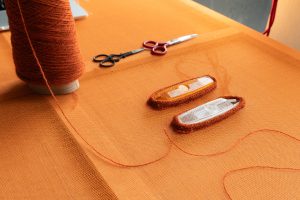
This body of work explores how censorship, absence, and imagination have shaped visual language and representations of intimacy in post-revolution Persian pop culture through non-masculine bodies. Drawing on Iranian calligraphy and working with dyed fabric, bleach, and collage, Kaeini creates ghost-like figures that appear through erasure rather than addition. The works reveal how censorship generated its own visual grammar, and how what is missing can remain deeply felt. Through painting and ink drawing, the artist revisits scenes and moments that were removed, altered, or never shown in post-revolution Iranian cinema, focusing on how intimacy and human connection were shaped by restriction.
Ali Kaeini (M.F.A. ’23) and Katya Muromtseva (M.F.A. ’24)
Hybrid Vistas, NIKA Project Space, Dubai
Nov. 11, 2025–July 2, 2026
Hybrid Vistas explores how landscape is transformed in an age of post-human thought, climate disruption, and hybrid perception.
Iranian artist Ali Kaeini examines themes of displacement and historical identity. Using recognizable images, motifs, and colors of Iranian architecture as a foundation, he creates complex geometric structures intertwined with organic spiral forms. Moving away from traditional painterly techniques, Kaeini develops his own approach, shifting our understanding of what a painting can be. He shows that the principle of collage can operate even within a traditional painterly language, giving each canvas its own landscape and boundaries.
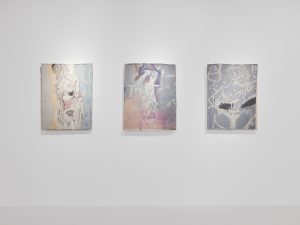
Katya Muromtseva’s abstract work from her new project No Such Thing As Day and Night serves as an example of art that is not tied to narrative, but instead lives through its own material and form. Here the artist disrupts the usual rhythm of narration. The paintings emerge through action itself, the viewer is not led through a story but drawn into presence, into an invented language that arise not from random gestures but from Muromtseva’s heightened sensitivity to current events: the ongoing wars, polarized political reality, and collapse of communication make it impossible to find adequate images for depicting our environment, transforming it into abstract formations of black patches and shifting chromatic tones.
Lead image from Ali Kaeini’s exhibition Missed Mist.