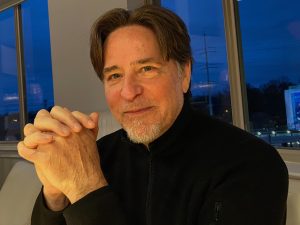
Shortly after graduating, Joe Cortina (B.F.A. ’76), walked down Broad Street in search of a job. After visiting a hardware store and a Sears department store, he walked into WTVR Channel 6, which had an opening for a part-time film editor. Within a year, he was in the director’s chair.
Since that first job, Cortina has built a career blending timeless artistic techniques with emerging digital media. He left Richmond to work for NBC News and, in the early 90s, helped design and directed the show Inside Stuff about the NBA.
“It was one of the first shows that combined pop culture and basketball and news, and we made it really creative and fun,” he says. “And the timing was just perfect. The NBA was hot—it was the era of the Dream Team, Michael Jordan, and Magic Johnson.”
The show was wildly successful. A year ago, Inside Stuff received the Curt Gowdy Media Award from the Basketball Hall of Fame, which recognized the show as one of the most innovative sports programs in the history of television.
Cortina was also the coordinating director for the 1992 Olympics in Barcelona, which led to an unexpected turn designing and directing the media for the Newseum, an interactive museum dedicated to journalism. He collaborated with renowned museum designer Ralph Appelbaum and fell in love with location-based, interactive media.
In 1999, he founded Cortina Productions. The company has grown into an award-winning design firm that produces multimedia experiences using state-of-the-art technology and innovative tools for expression. Their clients range from the National Air and Space Museum to the International Spy Museum to the Smithsonian National Museum of African American History and Culture.
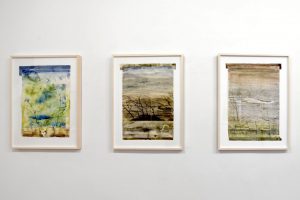
Cortina also continues to have a personal painting practice, allowing him to move fluidly between traditional and emerging media.
Here, Cortina talks about the unexpected lessons learned in art school that have prepared him for a varied career.
On Nov. 11, as part of the VCUarts Lecture Series, he’ll talk about how the lessons he learned at VCUarts set him up for a diverse career in art making, exhibit design, film, and television. Register to attend in person or virtually.
How did you know VCUarts was the right place for you?
I’ll give you a little anecdote. After I got into the Painting + Printmaking program, I took a class with the abstract expressionist Milton Resnick, who would come down from New York to teach. I remember one day we were all painting on our little canvases when he came sweeping into the room with a giant brush and started painting on everyone’s paintings. The whole room became an action painting.
Some people were mad, some people were crying, but I just thought, “I’ve found my place.” There was an expectation to not be timid or precious. We had to take chances.
When you were working in the newsroom—both in Richmond and with NBC—how did you begin to recognize the value of your art school training in the workplace?
When I was new to Channel 6, I didn’t know much about the controls, but I saw the camera had three knobs for red, green and blue. I noticed the anchor on the set was a little off color, so I adjusted the knobs. Everyone was surprised that I knew how to adjust the camera, but really, it was from art history. That’s where I learned about chiaroscuro and lighting.
But more broadly, as an artist, you solve problems with the things that you have, whether that’s a piece of cardboard and some crayons, or a canvas and paints, or a phone that can make videos. We make stuff—it’s just what we do.
How did those skills translate as you moved into a global market with NBC News?
When I was asked to be the coordinating director for the Olympics in Barcelona, I had no idea what I was doing. But Dick Ebersol, who was the president of NBC Sports, wanted it to look like a world event, not just a sporting event. I knew Spanish artists—Pablo Picasso, Joan Miró, Antoni Gaudí—and I went to Barcelona to take pictures of textures and paintings. I hired Jeremy Conway, another VCU alum and production designer who worked on Sex in the City, to design the sets using Catalan designers. We ultimately made a really authentic set that felt like Barcelona. I approach everything as an artist.
How did you begin to make the shift from news to museums?
When I started Cortina Productions with Jim Cortina and Amy Maddox, I was still directing television to fund the company. We started to build up a portfolio of museum and location-based projects.
At the time, curators were just beginning to discover that you couldn’t get kids to look at art or an artifact, read a plaque, and be done. They were starting to incorporate techniques from video games, theme parks and arcades into museums. With my television background and experience in art, I was able to build the company based on that changing environment.
What appealed to you about location-based media?
The television work I had done was mostly live and extremely structured. But this was about composing a space, not just a little rectangle. It felt like a huge opening.
The other thing that was exciting was that, in television, I always worked with the same disciplines: producers, directors, lighting designers, things like that. With museums, however, I was working with architects and exhibit designers and fabricators and a bunch of interesting creative people. Live television teaches you how to get a group of different people to work together at the same time. Everyone knows what the goals are. That was really useful in building the company and doing these projects. I knew how to get people to collaborate.
What advice do you have for students and young alumni looking to launch their creative careers?
Approach everything as an artist. Look at the materials you have, the goal of what you’re making, and do your best to make something. That ability will serve you in any career—in all kinds of things in life—and you’ll stand out from 90% of the people in the world.