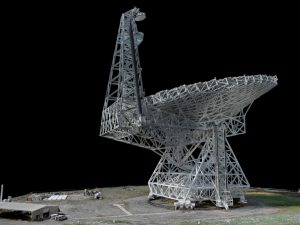
Nestled in the Allegheny Mountains of West Virginia sits the world’s largest movable radio telescope. Standing at 485 feet and surrounded by a National Quiet Zone—an where radio, wifi and battery signals are restricted—the Green Bank Telescope probes the furthest reaches of the universe.
Sterling Hundley, professor of Communication Arts, first came across the Green Bank Telescope in college, but a recent animation storytelling project led him to reach out about touring the observatory.
While standing atop the telescope, Hundley’s guide, Paul Vosteen, mentioned that the observatory didn’t have a 3D model of the telescope. An accurate 3D model could be used for structural analysis and to better understand how the metal frame could interfere with any signals from space.
“I said, ‘I think we could help with that,’” Hundley says.
After returning, Hundley brought his proposal to Jason Bennett, associate professor and chair of Communication Arts. They knew creating a model wouldn’t easy, between the electronic restrictions and the limited technology they had available. So, they decided to start with a scouting trip using a consumer drone to see if their idea was even feasible.
Before Bennett could fly the drone outside, he had to fly it inside an anechoic chamber at the observatory. This allowed the Green Bank team to measure the radio signal emitted by the drone so that it could later be filtered out of any noise the telescopes detected.
“We got through all of the hurdles and permissions [to use the drone],” Hundley says. “Jason scanned the telescope, then he built a prototype model. That was our proof of concept.”
As Bennett was building the prototype, Hundley had another serendipitous conversation—this time with Gian Lorenzo Ferretti and Dave Gedney of CoStar Group. Through a partnership between VCUarts and CoStar Group, Hundley has been teaching the Virtual Murals course, which places digital murals on LED screens at the company headquarters in downtown Richmond. He was describing the Green Bank project to Ferretti and Gedney, who were eager to get involved.
“They helped us level up our knowledge base, our resources, our hardware,” Hundley says.
Hundley, Bennett, Ferretti and Gedney returned to West Virginia with current senior Herbert Steet and then-student Cathryn Bryant (B.F.A. ’25), who documented the process on video.
“[We wanted] to encourage growth of arts research at VCU as well as future collaborations by offering a student’s perspective and emphasizing how meaningful this kind of education can be,” Bryant says.
Bennett also shared his earlier experiences with the CoStar Group’s drone pilot.
“There are weird idiosyncrasies of flying around a structure like that,” he says. “There are dead zones where the drone loses signal.”
CoStar Group has since completed 3D models of the telescope, as well as other smaller telescopes at the observatory. Bennett says a model of a 140-foot telescope is already in a virtual reality platform for use in the Applied Arts Lab (AAL), a projects-based course that integrates creativity, visual storytelling, and entertainment-technology pipelines into fields of health, science, and engineering.
The digital telescope model aligns well with the AAL, which blends classic design principles with modern visualization tools to explore ideas, create prototypes and influence innovation.
“We’re trying to ask the question, ‘Can entertainment, art and technology methodologies work with other disciplines to help relieve human suffering or solve problems?’” Bennett says. “I think this is a good example of a project like that. We’re taking entertainment art technology and then applying it to, in this case, an engineering problem.”
Hundley adds, “[We’re showing] we can go out in the world and sit at the table with the policymakers, the politicians, the engineers, the scientists and—through pictures, through creative thinking—we have tremendous value to add to those conversations.”