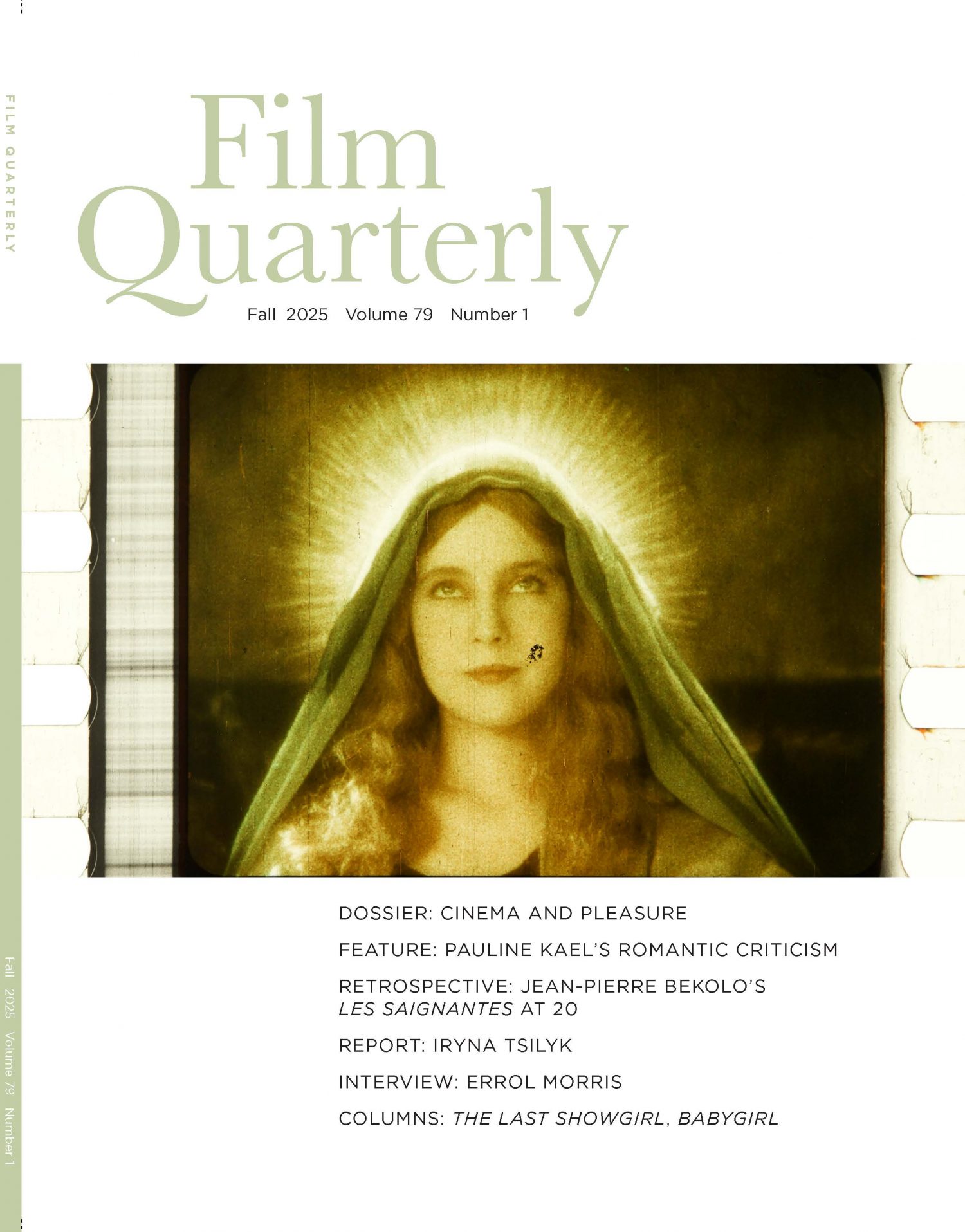
The venerable cinema journal Film Quarterly, which is based in the Cinema Program at VCUarts and edited by associate professor J. M. Tyree, has published its Fall issue. Undergraduate student Hamida Osman caught up with professor Tyree for an interview.
What does Film Quarterly mean to you?
I have worked with Film Quarterly in various roles for almost 20 years, starting out as a writer-at-large, continuing as a contributing editor, and now serving as editor-in-chief, with gratitude for the support of the University of California Press, which publishes FQ, and VCUarts, which supports my work through the Cinema Program. VCU Libraries makes FQ free to read on all VCU networks, and you can support the journal simply by reading our new issue and seeing where it takes you. I think FQ is a lively place of ideas where leading and emerging scholars discuss new and classic movies, TV, and books about film culture. I invite the VCU community to join in this great conversation.
The history of Film Quarterly stretches back to 1958 – I just realized that the journal is almost 30 years older than me! – and it is very distinguished, if I may say so. I think FQ is the oldest academic film journal in the USA and it has had so many great writers over the decades. The common thread is the journal’s focus on serious ideas that reach general readers. This has included classic essays by Pauline Kael (“Circles and Squares”) and Mark Fisher (“What is Hauntology?”), and interviews with filmmakers from elder statesmen like Errol Morris to new innovators like Raven Jackson. FQ’s recent issues have included great articles on popular films from The Substance and Anora to Wicked, with forthcoming articles in our next issue on Andor, Sinners, and other notable films and series of the year.
 Do you think you’ve taken a different approach than other editors of Film Quarterly?
My first article published in FQ was about the Showtime series Dexter, and my next editorial will be about the importance of the horror and thriller genre in the film releases of 2025. A little preview of coming attractions! Horror movies, while not to everyone’s taste, have become an increasingly important facet of the cinematic landscape, in part because they remain profitable productions designed for grown up audiences in a commercial setting where multiplex films usually must offer family movies instead, just in order to stay afloat. Horror is one genre that counters larger trends in several interesting ways.
Certainly FQ publishes on a much wider range of topics – we’ve recently featured dossiers on Hong Kong cinema culture and on Cinema and Pleasure, to be clear. But recent FQ articles on horror have included features on Rose Glass’s Love Lies Bleeding, Jane Schoenbrun’s I Saw the TV Glow, and Juliana Rojas and Marco Dutra’s Good Manners, as well as an essay about movie novelizations focused on bad horror movies (illustrated by some amazingly outrageous paperback book covers that must be seen to be believed…). Maybe I’m (over)emphasizing horror in my answer today simply because it’s October and Halloween is such a big thing in Richmond, here in the home ground of Edgar Allan Poe.
What do you hope students take away from Film Quarterly?
This is a very exciting topic to me. Whether they are filmmakers, visual artists, or film fans, I want VCU students to see how writing about the arts engages big ideas in ways that relate to life outside of the classroom. I hope FQ articles provoke student discussions about the relevance of the movies, TV, and streaming as culturally important forms of popular art. I also hope that the journal might help students articulate why the arts matter, not only to education at college, but also to conversations with people who might feel very distant from academia. In my view, it is so important to bridge these worlds so that folks see the relevance of academic research outside of specialized knowledge fields, and so that scholars are encouraged to write with general audiences in mind for communicating their ideas to the public. That is why FQ articles are regularly recommended by web sites like The Current at Criterion.com and the arts and culture blog 3Quarksdaily.
Another cool thing to mention is a more specific connection between FQ and VCUarts grads. Two of FQ’s editorial assistants have worked at the journal as part of their graduate school coursework, and both are graduates of the Cinema Program at VCUarts. FQ’s previous editorial assistant, Amani Hagmagid, is currently an MFA student at American University in DC. And the journal’s current editorial assistant, Sophia Schrock, is an MA student at CUNY in New York. As part of their professional development, both Amani and Sophia wrote book reviews for FQ that are published in the new issue. Amani reviewed Reel Freedom: Black Film Culture in Early Twentieth-Century New York City, by Alyssa Lopez (Temple University Press), and Sophia reviewed Queer for Fear: Horror Film and the Queer Spectator, by Heather O. Petrocelli (University of Wales Press). It’s wonderful for FQ to contribute to the education of a new generation of scholars as they progress from VCUarts into respected graduate programs in filmmaking and in film studies.