Navigating Paradox: An Interview with Artist Halima Bachir-Bouiadjra
Halima Bachir-Bouiadjra’s recent solo exhibition, A System of Exceptions, at The Anderson featured a dynamic installation on the second floor of the gallery. Bachir-Bouiadjra is an undergraduate student in Sculpture and Extended Media at VCUarts, and the work in this show originated in a course run by Sculpture Faculty Corin Hewitt. In the course, students were challenged to spend an entire semester on one sculpture, and Halima used the work she developed in the course to propose an exhibition through The Anderson’s annual Open Call for Student Exhibition Proposals in Spring of 2026. On acceptance, she developed the show in collaboration with the Curator of Student Exhibitions & Programs at The Anderson, Sarah Irvin. In this Q&A, Gallery Associate Priscila Santiago Hernandez, a graduate student in the Photography and Film Department, poses questions to Halima who shares the ideas behind her work, her experience learning plumbing and philosophy at VCUarts, and how she builds spaces that embrace contradiction.
Priscila Santiago Hernandez: Can you tell us about your exhibition on the second floor and what visitors encountered when they entered the gallery?
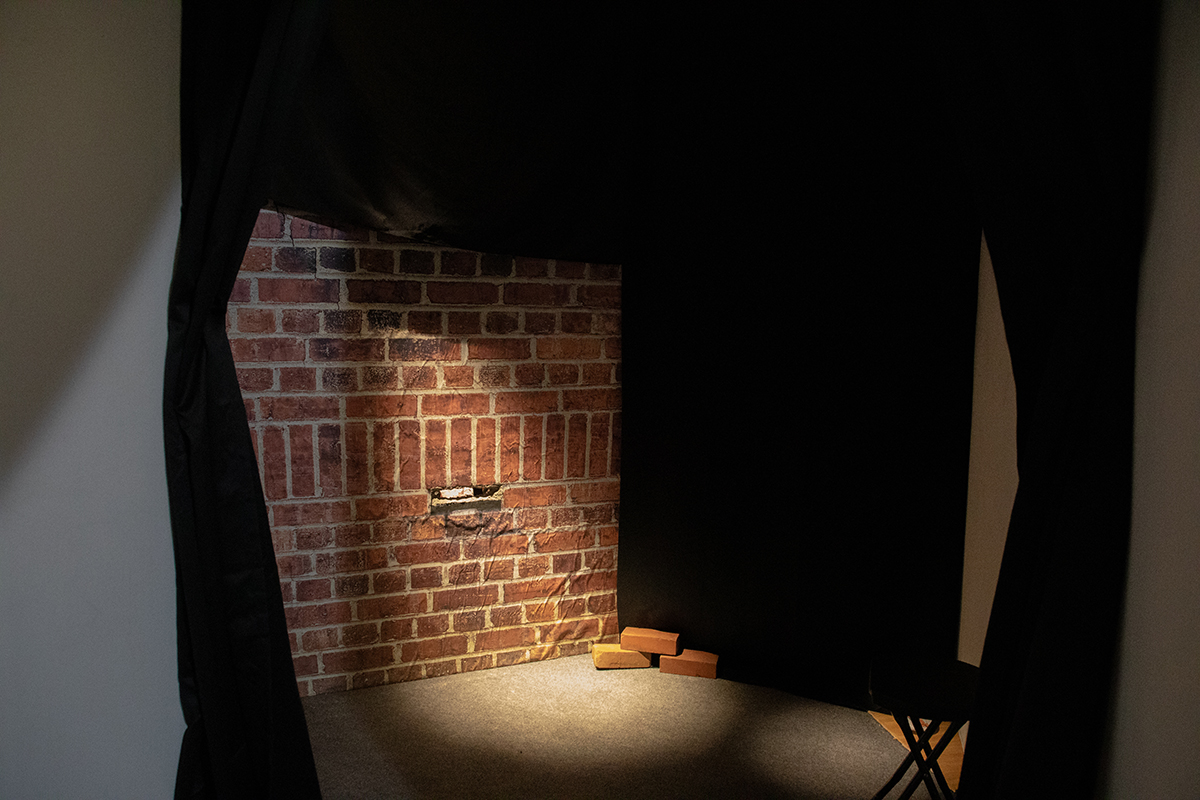
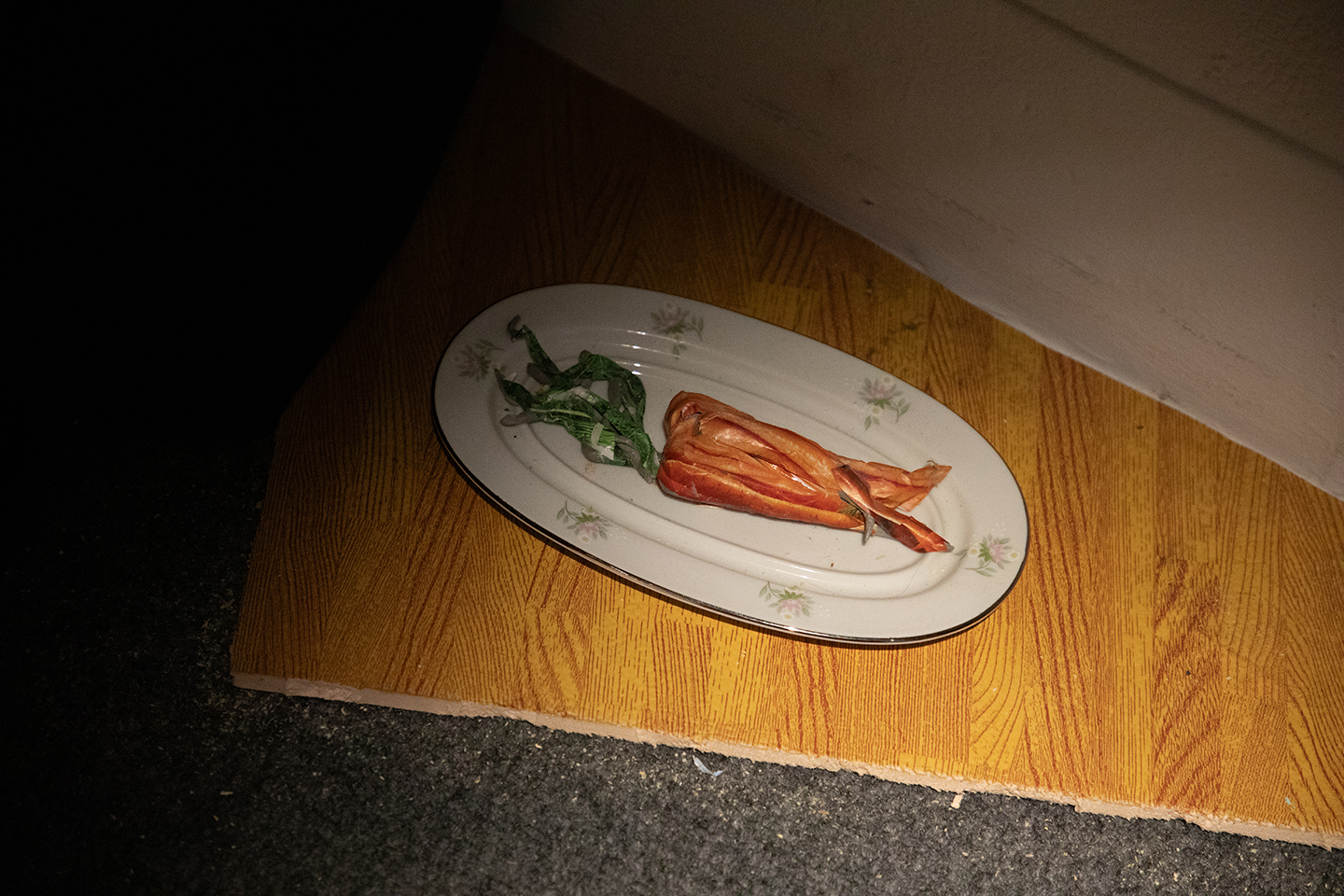
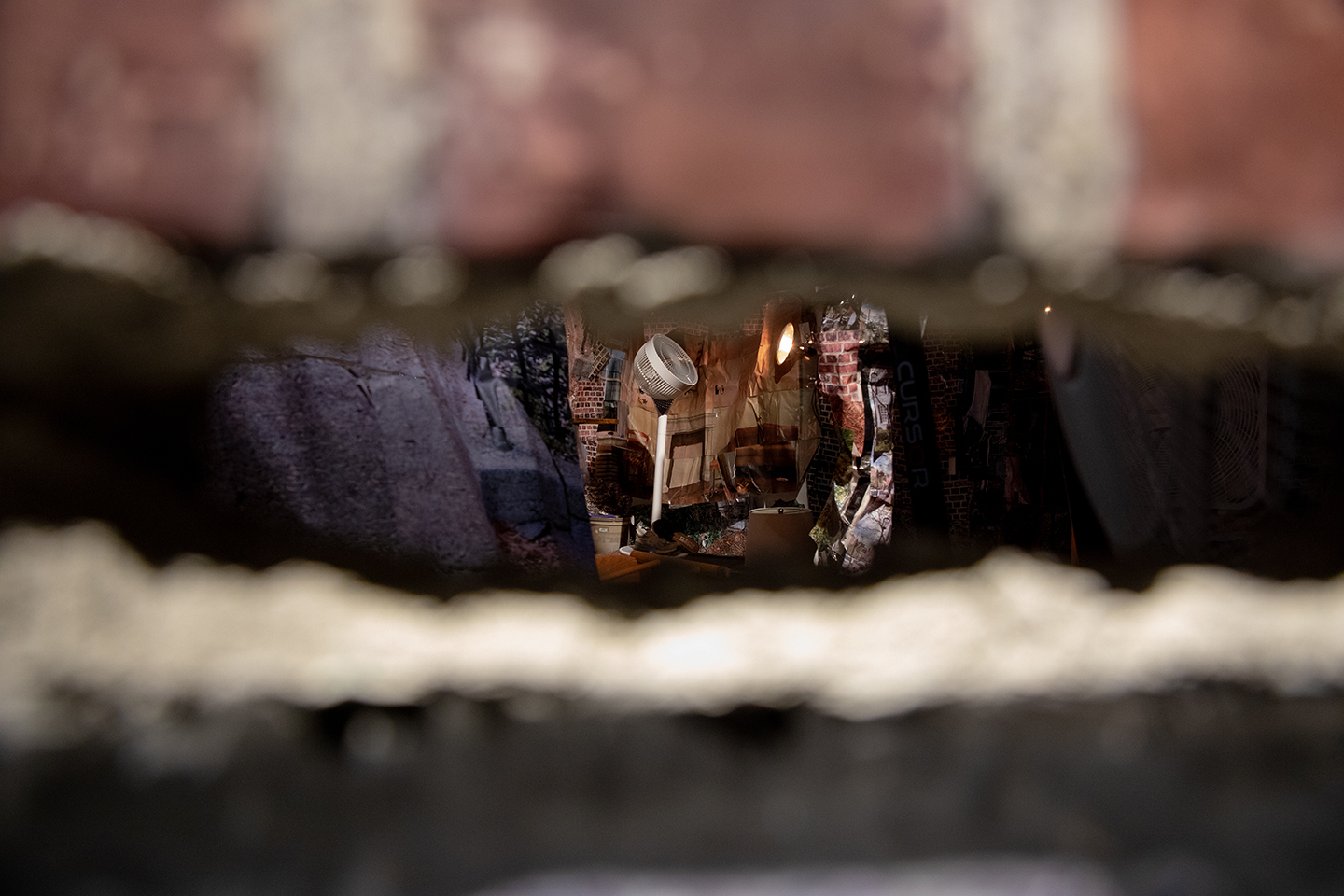
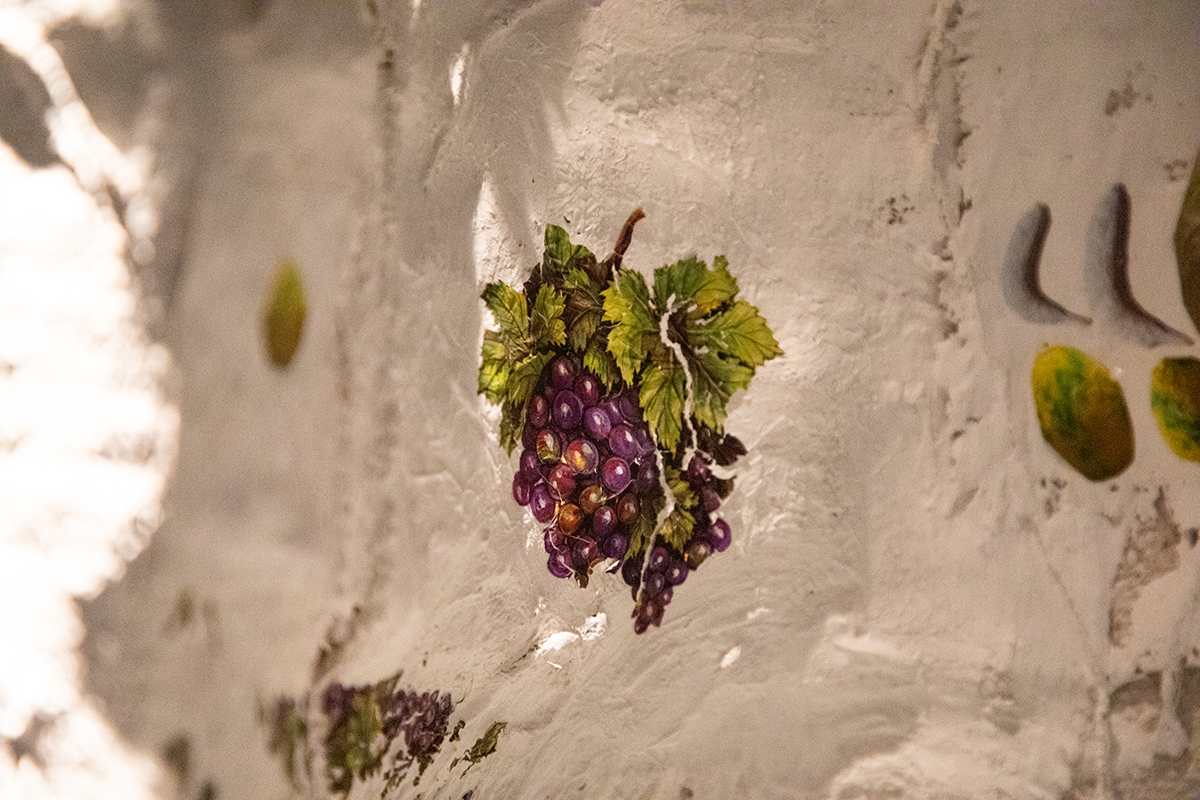
Halima Bachir-Bouiadjra: The exhibition brought together two installations: one, a recreated hole in a brick wall, and the other, a tall “fruit fountain.” The audience first encountered a chair suspended from the wall, alongside theatrically posed curtains that fold in on themselves. Their positioning disrupted the viewer’s sense of direction. On the left, the fruit fountain stood tall within a large basin-like structure, with three subsculptures catching the water that the main structure secretes. These three sculptures then tube and fed into one another, creating a strange dynamic between cause and effect. The recreated hole in the brick wall created another theatrical scene, with spotlights directed at the hole, a plated carrot, and a box containing scripts. The audience had to lean down and look into the hole to reveal the work.
 PSH: What themes or philosophical ideas inspired this body of work?
HBB: I was thinking a lot about how we use logic to make sense of things, and what happens when logic starts producing more questions than answers. Zeno’s paradox was important to me, particularly the idea that distance can be divided endlessly, and how that complicates our understanding of movement and time. I was also interested in the difference between something being impossible and something simply feeling impossible. A lot of the work plays with that gap. The fountain, for example, is recognizable, but its logic doesn’t quite add up. You can see the water, but you can’t understand where it comes from or where it goes. I wanted the spaces to feel as though they followed some kind of internal logic, even if that logic wasn’t available to the viewer.
 PSH: What does your studio practice look like when translating these abstract concepts into physical objects?
HBB: My process is pretty intuitive and loose. I journal a lot, mostly as a way of following my curiosity wherever it happens to go. I try not to be too selective about what feels worth thinking about. Sometimes it’s a larger idea, and sometimes it’s something completely random…a hole in a brick wall I walk past, for example. I like letting those small threads develop without knowing if they’ll become anything. Eventually, I usually feel the need to make something, and the ideas start to take a physical form. I work a lot with objects and printing, and I like seeing how something that started as a thought, or even just a passing curiosity, develops.
PSH: What was the most challenging or exciting technical aspect of bringing these installations together?
HBB: Both works were challenging and exciting in different ways. I was really excited to have a whole semester to develop something slowly and give myself time to actually work through the ideas behind it. Making the fountain was especially exciting because it was my first time working with plumbing and pumps. There was a lot of figuring things out as I went, which I really enjoyed. The other work was more mentally challenging. I was thinking about how to take a theory that I was interested in and push against it in a way that actually added something, rather than just repeating it or rejecting it. Figuring out how to do that was difficult, but it ended up being an important part of the work
 PSH: How has your experience at VCUarts influenced your creative approach, and what are you excited to explore next?
HBB: VCUarts has given me access to tools and ways of building that I probably wouldn’t have had otherwise, especially welding and working with machines. Having access to those things let me play more with utility…making objects that function, but in strange or unexpected ways. Next, I’m excited to collaborate more with my peers. I’ve been working with a close friend and classmate on something that feels really fresh to me. I’ve also been experimenting with video and sound, and thinking about how sculpture might exist without relying so much on physical material.
Images by Priscila Santiago Hernandez